Monday, February 20, 2017

Frederick McKinley Jones

Frederick McKinley Jones was born in Cincinnati, Ohio, on May 17, 1893. His father was a white railroad worker of Irish descent and his mother was black. It is believed that his mother died when he was young but her fate is unknown. His father struggled to raise him on his own. When Fred was eight years old, his father sent him to live with a priest in Kentucky. He wanted Fred to be exposed to an environment where he might have a better opportunity for gaining an education. Two years later, his father died.

Jones performed chores around the church in return for being fed and housed, cutting the grass, shoveling snow, scrubbing floors and learning to cook. At an early age, he demonstrated a great interest in mechanical working, whether taking apart a toy, a watch or a kitchen appliance. Eventually he became interested in automobiles, so much so that upon turning 12 years of age, he ran away from his home at the rectory and began working at the R.C. Crothers Garage in Cincinnati.

Initially hired to sweep and clean the garage, Jones spent much of his time observing the mechanics as they worked on cars. He developed an incredible base of knowledge about automobiles and their inner workings. Within three years, he had become the foreman of the garage. The garage was primarily designed to repair automobiles brought in by customers but it also served as a studio for building racing cars. After a few years of building these cars, he wanted to drive them and soon became one of the most well-known racers in the Great Lakes region. Jones eventually moved to Hallock, Minnesota to begin designing and building racecars, which he drove at local tracks and at county fairs. His favorite car was known as Number 15 and it was so well designed it not only defeated other automobile but once won in a race against an airplane.

On August 1, 1918 Jones enlisted in the United States Army and served in France during World War I. While serving, he recruited German prisoners of war and rewired his camp for electricity, telephone and telegraph service. After being discharged by the Army, Jones returned to Hallock in 1919. Looking for work, Jones often aided local doctors by driving them around for house calls during the winter season. When navigation through the snow proved difficult, he attached skis to the undercarriage of an old airplane body and attached an airplane propeller to a motor and soon whisked around town a high speeds in his new snow machine. Over the next few years Jones began tinkering with almost everything he could find, inventing things he could not find and improving upon those he could. When one of the doctors he worked for on occasion complained that he wished he did not have to wait for patient to come into his office for x-ray exams, Jones created a portable x-ray machine that could be taken to the patient. Unfortunately, like many of his early inventions, Jones never thought to apply for a patent for machine and watched helplessly as other men made fortunes off of their versions of the device. Unconcerned, Jones worked on other projects, including a radio transmitter, personal radio sets and eventually motion picture devices.

In 1927, to assist his friend with his movie theater, Jones converted scrap metal into the parts necessary to deliver a soundtrack to the video, he also devised ways to stabilize and improve the picture quality. When Joe Numero, the head of Ultraphone Sound Systems, heard about hiss devices, he invited Jones to come to Minneapolis for a job interview. After taking a position with the company, Jones began improving on many of the existing devices the company sold. Many of his improvements were so significant, representatives from AT&T and RCA sat down to talk with him and were amazed at the depth of his knowledge on intricate details, particularly in light of his limited educational background. Around this time, Jones came up with a new idea, an automatic ticket-dispensing machine to be used at movie theaters. He applied for and received a patent for this device in June of 1939 and the patent rights were eventually sold to RCA.

Joe Numero was presented wanted to develop a device which would allow large trucks to transport perishable products without them spoiling. Jones then developed a cooling process that could refrigerate the interior of the tractor-trailer. In 1939, Jones and Joe Numero received a patent for the vehicle air-conditioning device, which would later be called a Thermo King.

This product revolutionized several industries including shipping and grocery businesses. Grocery chains were now able to import and export products which previously could only have been shipped as canned goods. Thus, the frozen food industry was created and the supermarket emerged. Jones eventually modified the original design, so they could be used on trains, boats, and ships.

During World War II, the Department of Defense found a great need portable refrigeration units for distributing food, medicine, and blood plasma to troops in the field. The Department called upon Thermo King for a solution. Jones modified his device and developed a device that allowed airplanes to parachute these units down behind enemy lines to the waiting troops.

Frederick McKinley Jones died of lung cancer on February 21, 1961. He was recognized for his achievements both during his lifetime and after his death. In 1944, he became the first African American elected to the American Society of Refrigeration Engineers and was inducted into the Minnesota Inventors Hall of Fame in 1977. In 1991, President George H.W. Bush awarded him the National Medal of Technology posthumously becoming the first African American to receive the award.

General Benjamin O. Davis, Jr.

Benjamin Oliver Davis Jr. was born in Washington. D.C. on December 18, 1912. His father was a military officer, the first African American General in the United States Army. Benjamin, Sr. served in various capacities (beginning in the Spanish-American war) including serving in one of the original Buffalo Soldier regiments. His mother died from complications from childbirth in 1916 when Benjamin, Jr. was four years old.

When Davis, was 13 years old, he attended a barnstorming exhibition at Bolling Field in Washington, D.C. (now Bolling Air Force base). One of the pilots offered him the opportunity to accompany him on a ride in his plane. Davis enjoyed it so much that he became determined to pilot a plane himself one day.

In 1929, Davis enrolled at Western Reserve University but after a year, he transferred to the University of Chicago. Still desiring to serve as a military pilot, he contacted Illinois Representative Oscar De Priest, who sponsored him for a spot in the United States Military Academy at West Point, New York in 1932. Throughout his four years at the Academy, none of his classmates would speak to him outside the line of duty. None would be his roommate and none would sit with him to eat. Nonetheless, he graduated in 1936, finishing 35th in his class of 278. When he received his commission as a second lieutenant in the infantry, he became one of only two Black combat officers in the United States Army, the other being his father. Davis earned the respect of his classmates, as evidenced by the note beneath his picture in the 1936 yearbook, the Howitzer:

"The courage, tenacity, and intelligence with which he conquered a problem incomparably more difficult than plebe year won for him the sincere admiration of his classmates, and his single-minded determination to continue in his chosen career cannot fail to inspire respect wherever fortune may lead him."

Because of his high standing in his graduating class, Davis should have had his choice of assignments, but when he opted to apply for the Army Air Corps he was denied because the Air Corps did not accept black soldiers. He was instead assigned to the 24th Infantry Regiment, an all-Black division located in Fort Benning, Georgia. Although an officer, he was not permitted to enter the officers club on the base. After attending the U.S. Army Infantry School, he followed in his father’s footsteps and traveled to Tuskegee, Alabama to teach a military tactics course at the Tuskegee Institute. On June 19, 1939, he was promoted to the rank of First Lieutenant and then to Captain.

Despite the prestige of being an instructor, Davis still wanted to fly. Fortunately, in 1941, the Roosevelt administration, in response to public pressure for greater black participation in the military as war approached (World War II), ordered the War Department to create a black flying unit. Captain Davis was assigned to the first training class at Tuskegee Army Air Field and in March 1942, earned his wings as one of five black officers to complete the course. He was the first black officer to solo an Army Air Corps aircraft. Davis was promoted to the rank of Lieutenant Colonel and in July 1942, he was assigned as the commander of the first all-black air unit, the 99th Pursuit Squadron, known by history as the Tuskegee Airmen.

The squadron, equipped with Curtiss P-40 fighters, was sent to Tunisia in North Africa in the spring of 1943. On June 2, they saw combat for the first time in a dive-bombing mission against the German-held island of Pantelleria as part of Operation Corkscrew. They also took part in the allied invasion of Sicily. In September 1943, Colonel Davis was recalled to Tuskegee to take over a larger all-black unit preparing for combat in Europe, the 332nd Fighter Group.

Almost immediately, however, problems arose for Colonel Davis. A number of Senior Army Air Corps officers complained to Army Chief of Staff George Marshall that the 99th Fighter Squadron had underperformed and should thereafter be taken out of combat. Major General Edwin House, Commander of the XII Air Support Command wrote in September 1943 that “the Negro type has not the proper reflexes to make a first-class fighter pilot.” Davis argued that no information had been presented to him that showed anything to suggest that the Black fighter pilots had performed unsatisfactorily. He presented his case to the War Department and held a press conference at the Pentagon. General Marshall called for an inquiry but allowed the 99th Squadron to continue to fight while the investigation continued. When the results of the inquiry came back, the 99th Squadron was vindicated and found to have performed similarly to other fighter squadrons. Any continuing arguments ceased in January 1944 when the squadron shot down 12 German fighters in a two days.

Soon thereafter Colonel Davis and the 332nd Fighter Group arrived in Italy where they were based at Ramitelli Airfield. The 332nd, called the Red Tails because of the distinctive paint scheme on the tails of their planes, performed well as bomber escorts, often being requested by bomber pilots because of their insistence on not abandoning the bombers. Colonel Davis was awarded the Silver Star for a mission in Austria and won the Distinguished Flying Cross for a bomber-escort mission to Munich, Germany in June, 1944. In 1945, Colonel Davis was placed in charge of all-black 477th Bombardment Group stationed at Godman Field in Kentucky.

By the end of the war, the airmen commanded by Colonel Davis had an outstanding record in combat. They flew more than 15,000 raids, shot down 111 enemy planes, and destroyed or damaged 273 on the ground at a cost of 66 of their own planes and losing only about 25 bombers.

After the end of World War II, new President Harry S. Truman signed Executive Order 9981 to fully integrate the military branches. Colonel Davis was called upon to help draft the new Air Force plan for carrying out this order. For the next few years he was assigned to the Pentagon and to posts overseas. When the Korean War broke out, he once again participated in the fighting, manning an F-86 fighter jet and leading the 51st Fighter-Interceptor Wing.

In the summer of 1949, Davis was assigned to attend the Air War College. He was the first African American permitted to attend the college and it was significant because further promotion was dependent upon successful graduation. Davis excelled and, upon graduation, received an assignment to serve at the United States Air Force Headquarters at the Pentagon.

Davis next served as Director of Operations and Training at Far East Air Forces Headquarters, Tokyo from 1954 until 1955, when he was assigned the position of Vice Commander, Thirteenth Air Force. He was promoted to the rank of Brigadier General, becoming the first African American General in the Air Force, in May 1960 and to Major General in January 1962. General Davis was promoted to the rank of Lieutenant General in April 1965 and retired from active duty on February 1, 1970 after more than 33 years of military service.

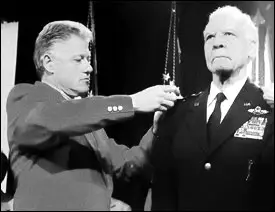
General Davis did not slow down upon his retirement, instead moving on to other ways to serve. In 1970 he was put in charge of the Federal Sky Marshall Program and in 1971, he was named Assistant Secretary of Transportation for Environment, Safety, and Consumer Affairs. In this role, he oversaw the creation and implementation of airport security and highway safety programs and procedures. After retiring from the Department of Transportation in 1975, he served on the American Battle Monuments Commission. Finally, on December 9, 1998, President Bill Clinton decorated General Davis with a four-star insignia, advancing him to the rank of General, U.S. Air Force.


General Benjamin O. Davis, Jr. passed away on July 4, 2002 and was buried with full military honors on July 17, 2002 at Arlington National Cemetery. His military decorations include:

  • Air Force Distinguished Service Medal
  • Army Distinguished Service Medal
  • Air Medal with four oak leaf clusters
  • Philippine Legion of Honor
  • Legion of Merit with two oak leaf clusters
  • Air Force Commendation Medal with two oak leaf clusters
  • Silver Star
  • Distinguished Flying Cross

"General Davis is here today as living proof that a person can overcome adversity and discrimination, achieve great things, turn skeptics into believers; and through example and perseverance, one person can bring truly extraordinary change" – President Bill Clinton

Friday, February 17, 2017

Jesse Jackson

Jesse Louis Burns was born on October 8, 1941, in Greenville, South Carolina. His parents, Helen Burns, a high school student at the time of her son's birth, and Noah Robinson, a 33-year-old married man who was her neighbor, never married. A year after Jesse's birth, his mother married Charles Henry Jackson, a post office maintenance worker, who later adopted Jesse. He grew up during segregation. He and his mother had to sit in the back of the bus and his black elementary school lacked the amenities the town's white elementary school had. "There was no grass in the yard," Jackson later recalled. "I couldn't play, couldn't roll over because our school yard was full of sand. And if it rained, it turned into red dirt."

In school Jackson was a good student and an exceptional athlete. In 1959 attended the University of Illinois on a football scholarship. But Jackson spent just a year at the largely white school before transferring to the Agricultural and Technical College of North Carolina (now North Carolina Agricultural and Technical State University) in Greensboro, where he got involved in the civil rights demonstrations in the town. It was during this time that he also met Jacqueline Lavinia Brown, whom he married in 1962.

In 1964, Jackson graduated from college with a degree in sociology. The next year he went to Selma, Alabama, to march with Dr. Martin Luther King, Jr., eventually becoming a worker in Dr. King's Southern Christian Leadership Conference (SCLC). In 1966, he moved to Chicago, where he did graduate work at the Chicago Theological Seminary. Jackson decided to leave school in order to work for Dr. King, who appointed him director of Operation Breadbasket, the economic arm of the SCLC. But his time with the SCLC was not entirely smooth. Many felt that Jackson acted too independently. After Dr. King’s assassination, he resigned from the organization in 1971.

The same year Jackson left the SCLC, he founded Operation PUSH (People United to Save Humanity). Jackson created the organization, based in Chicago, in order to advocate black self-help. In 1984, he established the National Rainbow Coalition, whose mission was to establish equal rights for all minorities. He called for Arab Americans, Native Americans, Asian Americans, youth, disabled veterans, small farmers, African Americans, women, Jewish Americans, and homosexuals to all join together. The two organizations merged in 1996 to form the Rainbow/PUSH Coalition. The merged entity advocates for minorities. Its main economic goal is to have more minorities on the payrolls, in the boardrooms, and on the supplier lists of major corporations. The industries it most aggressively pursues are the financial sector on Wall Street, the telecommunications field, and high-tech firms in Silicon Valley.

In the 1970s, Jackson began traveling around the world to mediate or spotlight problems and disputes. He visited South Africa in 1979 and spoke out against the country's apartheid policies, and later traveled to the Middle East to throw his support behind the creation of a Palestinian state. He also got behind democratic efforts in Haiti.

In 1984, Jackson became the second African American (preceded by Shirley Chisholm) to make a national run for the United States presidency. The campaign was largely successful. Jackson placed third in the Democratic primary voting and garnered a total of 3.5 million votes, 18.2 percent of the total. He won 5 primaries. In 1988, Jackson made a second presidential run. This time he was better financed and organized. He more than doubled his previous results and finished second in the Democratic primaries to Massachusetts Governor Michael Dukakis. Jackson won 6.9 million votes, winning 7 primaries and 4 caucuses.

While Jackson declined to run for the U.S. presidency again, he's continued to push for African American rights. There's no denying his impact on American politics and civil rights. In 2000 President Clinton awarded Jackson the Presidential Medal of Freedom. That same year he received a Master of Divinity degree from the Chicago Theological Seminary.

Wednesday, February 15, 2017

Matthew Henson

Matthew Alexander Henson was born on August 8, 1866, in Nanjemoy, Maryland. His parents were sharecroppers who were free people. Henson lost his mother when he was two years old and his father remarried. In 1870, his family moved to Washington, DC, in search for work opportunities. His father died there a few years later, leaving Henson in the care of his uncle. His uncle took a great deal of interest in his education, paying for it for several years. However, his uncle died when he was 11, leaving Henson to support himself.

At the age of 11, Henson left DC to find his own way. After working briefly in a restaurant as a dishwasher, he walked all the way to Baltimore, Maryland, and found work as a cabin boy on the merchant ship Katie Hines. Captain Childs took Henson under his wing and saw to his education, which included instruction in the finer points of seamanship as well as to read and write.

Henson sailed around the world with Captain Childs for several years, gaining experience as a crewman on the ship and learning about many countries. Visiting Europe, Asia, Africa, and Russia, Henson was exposed to cultures and languages of the different regions.

In 1883 Captain Childs died, and Henson eventually made his way back to Washington, DC, where he found work as a clerk in a hat shop. It was there that he met Commander Robert E. Peary, an explorer and officer in the U.S. Navy Corps of Civil Engineers. Peary had been ordered to do a survey for the proposed Nicaragua Canal. In preparing to go south, he had stopped in the store to purchase a sun hat and to sell some of the seal and walrus pelts he had collected in Greenland. He and Henson discussed their travels. Henson had the skill set Peary needed and he asked Henson to join him as his personal valet.

During their two years in Central America, Peary told Henson of his desire to explore the Arctic Circle, it became a goal for Henson too. He traveled with Peary to explore parts of Greenland in 1891. While there, Henson embraced the local Eskimo culture, learning the language and the natives' Arctic survival skills over the course of the next year. But by the end of the journey, all of the other members of the team had abandoned the venture, leaving Peary and Henson alone.

Their next trip to Greenland came in 1893, this time with a goal of charting the entire ice cap. The two-year journey almost ended in tragedy, with Peary's team on the brink of starvation; members of the team managed to survive by eating all but one of their sled dogs. Despite this perilous trip, the explorers returned to Greenland in 1896 and 1897, to collect three large meteorites they had found during their earlier quests, ultimately selling them to the American Museum of Natural History and using the proceeds to help fund their future expeditions.

Over the next several years, Peary and Henson would make multiple attempts to reach the North Pole. Their 1902 attempt proved tragic, with six Eskimo team members perishing due to a lack of food and supplies. However, they made more progress during their 1905 trip: Backed by President Theodore Roosevelt and armed with a then state-of-the-art vessel that had the ability to cut through ice, the team was able to sail within 175 miles of the North Pole. Melted ice blocking the sea path thwarted the mission’s completion, forcing them to turn back. Around this time, Henson fathered a son, Anauakaq, with an Inuit woman, but back at home in 1906 he married Lucy Ross.

The team's final attempt to reach the North Pole began in 1908. Henson proved an invaluable team member, building sledges and training others on their handling. Of Henson, expedition member Donald Macmillan once noted, "With years of experience equal to that of Peary himself, he was indispensable."

The expedition continued into the following year, and while other team members turned back, Peary and the Henson trudged on. On April 6, 1909, Peary, Henson, four Eskimos and 40 dogs (the trip had begun with 24 men, 19 sledges and 133 dogs) finally reached the North Pole, planting the American flag into the ground at, what is now known as, Camp Jesup.

When they returned to the United States, Peary received many accolades for his accomplishment. Peary was celebrated everywhere he went, but as an African American, Henson was largely forgotten and ignored. He spent the next 30 years working as a clerk in a New York federal customs house.

In 1937, a 70-year-old Henson finally received the acknowledgment he deserved: The highly regarded Explorers Club in New York accepted him as an honorary member. In 1944 he and the other members of the expedition were awarded a Congressional Medal.

Matthew Henson died in New York City on March 9, 1955, and was buried in Woodlawn Cemetery. In a move to honor Henson, in 1987, President Ronald Reagan approved the transportation of Henson remains for reinterment at Arlington National Cemetery. The national cemetery is also the burial site of Peary.

Percy Julian

Percy Lavon Julian was born April 11, 1899, in Birmingham, Alabama. His father was a railroad mail clerk, his mother was a school teacher, and his grandparents were former slaves. Julian grew up in the time of the Jim Crow culture. Among his childhood memories was finding a lynched man hanged from a tree while walking in the woods near his home. He attended school through the eighth grade but there were no high schools open to black students. The family moved to Montgomery where he attended high school at the State Normal School for Negroes. Julian applied to DePauw University in Greencastle, Indiana, where he had to take high school-level classes in the evening, along with his freshman level courses, to get him up to the academic level of his peers. In spite of this challenging beginning, he graduated first in his class in 1920 and was a member Phi Beta Kappa, a liberal arts and sciences honor society. Though he was the class valedictorian, Julian was discouraged from seeking admission into a graduate school because future coworkers and employers wouldn’t like a black man having a graduate level education. Instead, he took the advice of an advisor and took a position as a chemistry teacher at Fisk University, a Black college in Nashville, Tennessee.

After two years at Fisk. Julian received the Austin Fellowship in Chemistry to attend Harvard University to finish his studies. He achieved straight A’s, finished at the top of his class, and received a Masters Degree in 1923. Even with this success, Julian was unable to obtain a position as a teaching assistant at any major universities because of the perception that White students would refuse to learn under a Black instructor. Thus, he moved on to a teaching position at West Virginia State College for Negroes, though he did not enjoy his situation in West Virginia. He eventually left West Virginia and served as an associate professor of chemistry at Howard University in Washington, D.C.

In 1929, Julian qualified for and received a Fellowship from the General Education Board and traveled to Vienna, Austria in pursuit of a Ph.D. degree. While in Vienna, Julian developed a fascination with the soybean and its interesting properties and capabilities. Focusing on organic chemistry, Julian received his Ph.D. in 1931 and returned to the United States and to Howard, as the head of the school’s chemistry department. Julian met his wife, Anna Roselle, while employed at Howard University, and the two were accused of having an affair while she was married to one of his colleagues. A scandal ensued and Julian and Anna left and moved back to DePauw, where he was appointed a teacher in organic chemistry. At DePauw, he worked on synthesizing physostigmine from the calabar bean (the seed of an African plant) to create a drug treatment for glaucoma. Julian was successful and became internationally hailed for his achievement. The Dean of the university decided to appoint Julian to the position as Chair of the chemistry department but was talked out of it because of concerns over reaction to his race.

Desiring to leave academia, Julian applied for jobs at prominent chemical companies, but was repeatedly rejected when hiring managers discovered that he was black. Ultimately, he obtained a position at the Glidden Company as chief chemist and the Director of the Soya Product Division. This was a significant development as he was the first Black scientist hired for such a position. The Glidden Company was a leading manufacturer of paint and varnish and was counting on Julian to develop compounds from soy-based products which could be used to make paints and other products. There Julian invented Aero-Foam, a product that uses soy protein to put out oil and gas fires and was widely used in World War II by the United States Navy.

On December 24, 1935, Percy married Anna and settled into their life in Chicago. Percy continued his biomedical work as he next developed a way to inexpensively develop male and female hormones from soy beans. These hormones would help to prevent miscarriages in pregnant women and would be used to fight cancer and other ailments. He next set out to provide a synthetic version of cortisone, a product which greatly relieved the pain of suffered by sufferers of rheumatoid arthritis. The real cortisone was extremely expensive and only rich people could afford it. With Julian's discovery of the soy-based substitute, millions of sufferers around the world found relief at a reasonable price. In 1950, the City of Chicago named him Chicagoan of the Year for his work. Even with this honor, the white people in his community did not accept him. When he purchased a house in Oak Park, the home was set afire by an arsonist on Thanksgiving day 1950. A year later, dynamite was thrown from a passing car and exploded outside the bedroom window of his children. Despite the fact that many residents of the town relied upon his methods to relieve their pains of and provide for their safety, some still could not stand to have him as their neighbor simply because he was Black

In 1954, Julian left the Glidden Company to establish Julian Laboratories which specialized in producing his synthetic cortisone. When he discovered that wild yams in Mexico were even more effective than Soya beans for some of his products, he opened the Laboratorios Julian de Mexico in Mexico City, Mexico which cultivated the yams and shipped them to Oak Park for refinement. In 1961, he sold the Oak Park plant to Smith, Kline and French, a giant pharmaceutical company, for 2.3 million dollars, becoming one of the first black millionaires. He then found Julian Research Institute, a nonprofit organization that he ran for the rest of his life.

Julian spent years struggling for respect in his field. He was finally recognized when he became the first black chemist elected to the National Academy of the Sciences, in 1973. He also received the Spingarn Medal from the NAACP. Percy Julian died of liver cancer in 1975. Since his death, he received countless awards. In 1990, he was elected to the National Inventors Hall of Fame and in 1999 his synthesis of physostigmine was recognized by the American Chemical Society as “one of the top 25 achievements in the history of American chemistry.” Percy Julian is known worldwide as a trailblazer, both in the world of chemistry and as an advocate for the plight of Black scientists.

Monday, February 13, 2017

Whitney Young, Jr.

Whitney M. Young, Jr. was born on July 31, 1921, in Lincoln Ridge, Kentucky. His mother was a teacher and his father the principal of the Lincoln Institute, an African American college prep school. Young attended the Lincoln Institute and graduated as his class valedictorian. In 1941, he graduated from Kentucky State Industrial College (now Kentucky State University) with his bachelor of science in social work. During this time at Kentucky State, Young was a forward on the university's basketball team; a member of Alpha Phi Alpha fraternity, where he served as the vice president; and the president of his senior class.

During World War II, Young was trained in electrical engineering at the Massachusetts Institute of Technology. He was then assigned to a road construction crew of black soldiers supervised by Southern white officers. After just three weeks, he was promoted from private to first sergeant, creating hostility on both sides. Young was able to mediate effectively between his white officers and black soldiers angry at their poor treatment. This situation propelled him into a career in race relations.

Young married his college sweetheart, Margaret Buckner, in 1944. After the war, he joined Margaret at the University of Minnesota, where he earned a master's degree in social work in 1947 and volunteered for the St. Paul branch of the National Urban League. With the organization making strides in placing African Americans in previously whites-only employee positions, he was then appointed as the industrial relations secretary in 1949.

Young became president of the League's Omaha branch in 1950 and was at the forefront of racial integration in the region. Under his leadership, the chapter tripled its number of paying members. While he was president of the Omaha Urban League, Young taught at the University of Nebraska from 1950 to 1954, and Creighton University from 1951 to 1952. Then in 1954, he took a position as dean of Atlanta University's School of Social Work, remaining actively involved in the Civil Rights Movement and becoming the president of state branch of the NAACP.

Young was appointed executive director of the National Urban League in 1961. He was unanimously selected by the National Urban League's Board of Director. With a talent for enlisting the support of prominent white businessmen, he was instrumental in saving the league from financial ruin as well as handling major overhauls of the organization's structure, grandly increasing its budget and staff size. Within four years he expanded the organization from 38 employees to 1,600 employees; and from an annual budget of $325,000 to one of $6,100,000. Young served as President of the Urban League until his death in 1971.

The Urban League had traditionally been a cautious and moderate organization with many white members. During Young's ten-year tenure at the League, he brought the organization to the forefront of the American Civil Rights Movement. He both greatly expanded its mission and kept the support of influential white business and political leaders. Young expressed the mission of the Urban League not as ground-level activism in itself but as “the supplement and complement of the activities of all other organizations” “We are the social engineers, we are the strategists, we are the planners, we are the people who work at the level of policy-making, policy implementation, the highest echelons of the corporate community, the highest echelons of the governmental community – both at the federal, state and local level – the highest echelons of the labor movement.” As part of the League's new mission, Young initiated programs like "Street Academy", an alternative education system to prepare high school dropouts for college, and "New Thrust", an effort to help local black leaders identify and solve community problems. He also pushed for federal aid to cities, proposing a domestic "Marshall Plan". This plan, which called for $145 billion in spending over 10 years, was partially incorporated into President Lyndon B. Johnson's War on Poverty.

As executive director of the League, Young pushed major corporations to hire more African Americans. In doing so, he fostered close relationships with CEOs. He stressed the importance of working within the system to effect change. Still, he was not afraid to take a bold stand in favor of civil rights. In 1963, as one of the “Big Six”, Young was one of the organizers of the March on Washington despite the opposition of many white business leaders. The League, at Young's request, became a co-sponsor of the March on Washington.

Young was an important advisor to Presidents Kennedy, Johnson, and Nixon. In 1968, representatives of President-elect Richard Nixon tried to interest him in a Cabinet post, but Young refused, believing that he could accomplish more through the Urban League. Young had a particularly close relationship with President Johnson, and in 1969, Johnson honored him with the highest civilian award, the Presidential Medal of Freedom.

After visiting troops in the Vietnam War, Young established a veteran affairs department for the League. With the advent of the Black Power movement, he was often seen as too conservative and pacifying in his views. Yet he did adopt the New Thrust program in the late '60s, which focused on the direct economic empowerment and actualization of urban communities.

Young served as President of the National Association of Social Workers (NASW), from 1969 to 1971. He took office at a time of fiscal instability in the association and uncertainty about President Nixon's continuing commitment to the "War on Poverty" and to ending the war in Vietnam. Young spent his tenure as President of NASW ensuring that the profession kept pace with the troubling social and human challenges it was facing. NASW News articles document his call to action for social workers to address social welfare through poverty reduction, race reconciliation, and putting an end to the War in Vietnam.

Whitney Young, Jr. died on March 11, 1971, at the age of 49, while attending a conference in Lagos, Nigeria. While swimming at a beach, he had a heart attack and drowned. President Nixon sent a plane to Nigeria to collect his body and traveled to Kentucky to deliver the eulogy at the funeral. In his eulogy, President Nixon said this of Young:

“And so today Whitney Young's message to America---the country that he loved with all of its faults, loved it because he realized that this was a country in which we had the power to change what was wrong and change it peacefully--Whitney Young's message is this: "What can I do? What can I do to make this a better country? What can I do through helping others, through recognizing their equality, their dignity, their individuality, to realize the American dream?"

His dream, if I may paraphrase, was one Nation, under God, indivisible, with liberty and justice and opportunity for all. To fulfill his dream is the responsibility of each of us. It is the commitment that each of us makes in his heart on this day.”

Abraham Lincoln

Abraham Lincoln was born in a log cabin in Hardin County, Kentucky. Due to a land dispute, the Lincolns were forced to move from Kentucky to Perry County, Indiana in 1817, where the family "squatted" on public land to scrap out a living in a crude shelter, hunting game and farming a small plot. The family was eventually able to buy the land.

When Abraham was 9 years old, his mother died on October 5, 1818, of tremetol (milk sickness) at age 34. This was devastating on him and Abraham grew more alienated from his father and resented the hard work placed on him at an early age. Just over a year after his mother’s death, his father married a Kentucky widow with three children of her own. She was a strong and affectionate woman with whom Abraham quickly bonded. Though both his parents were illiterate, his stepmother encouraged Abraham to read. Because reading material was in short supply in his town, Abraham would walk for miles to borrow a book.

In March, 1830, the family moved to Macon County, Illinois. But when his father moved the family again to Coles County, the 22-year-old Abraham Lincoln struck out on this own, making a living in manual labor. He was known for his skill in wielding an ax and early on made a living splitting wood for fire and rail fencing. Lincoln eventually moved to New Salem, Illinois, where he worked as a shopkeeper, postmaster, and eventually general store owner. It was here that Lincoln, working with the public, acquired social skills and honed story-telling talent that made him popular with the locals. When the Black Hawk War broke out in 1832 between the United States and Native Americans, the volunteers in the area elected Lincoln to be their captain. He saw no combat during but made several political connections.

After the Black Hawk War, Lincoln began his political career and was elected to the Illinois state legislature, in 1834. He supported the Whig politics of government-sponsored infrastructure and protective tariffs. This led him to formulate his early views on slavery, as “an impediment to economic development”. It was around this time that he decided to become a lawyer, teaching himself the law by reading William Blackstone's “Commentaries on the Laws of England.” After being admitted to the bar in 1837, he moved to Springfield, Illinois, and began to practice at a law firm. Lincoln made a good living in his early years as a lawyer, but found that Springfield alone didn't offer enough work, so to supplement his income, he followed the court as it made its rounds on the circuit to the various county seats in Illinois.

Lincoln served a single term in the U.S. House of Representatives from 1847 to 1849. He was the lone Whig from Illinois and found few political allies. He used his term in office to speak out against the Mexican-American War and supported Zachary Taylor for president in 1848. His criticism of the war made him unpopular back home and he decided not to run for second term, but instead returned Springfield to practice law.

By the 1850s, the railroad industry was moving west and Illinois found itself becoming a major hub for various companies. Lincoln served as a lobbyist for the Illinois Central Railroad as its company attorney. Success in several court cases brought other business clients as well, banks, insurance companies, and manufacturing firms.

In 1840, Lincoln became engaged to Mary Todd, a high spirited, well-educated woman from a distinguished Kentucky family. Although they broke the engagement in 1841, they eventually married on November 4, 1842. The couple had four children, of which only one, Robert, survived to adulthood.

In 1854, Congress passed the Kansas-Nebraska Act, which repealed the Missouri Compromise, and allowed individual states and territories to decide for themselves whether to allow slavery. The law provoked violent opposition in Kansas and Illinois, and it gave rise to the Republican Party. This awakened Lincoln's political enthusiasm once again, and his views on slavery moved more toward moral indignation. Lincoln joined the Republican Party in 1856.

In 1857, the Supreme Court issued its controversial decision Scott v. Sanford, declaring African Americans were not citizens and had no inherent rights. Though Lincoln felt African Americans were not equal to whites, he believed the America's founders intended that all men were created with certain inalienable rights. Lincoln decided to challenge sitting U.S. Senator Stephen Douglas for his seat. In his nomination acceptance speech, he criticized Douglas, the Supreme Court, and President Buchanan for promoting slavery and declared "a house divided cannot stand."

The 1858 Senate campaign featured seven debates held in different cities across Illinois. The two candidates debated on issues ranging from states' rights to western expansion, but the central issue was slavery. In the end, the state legislature elected Douglas, but the exposure vaulted Lincoln into national politics.

In 1860, political operatives in Illinois organized a campaign to support Abraham Lincoln for the presidency. On May 18, at the Republican National Convention in Chicago, Lincoln surpassed better known candidates and won the nomination. His nomination was due in part to his moderate views on slavery, his support for improving the national infrastructure, and the protective tariff. In the general election, Lincoln faced his rival, Stephan Douglas, this time besting him in a four-way race that included John C. Breckinridge of the Southern Democrats and John Bell of the Constitution Union. Lincoln received 39.8 percent of the popular vote, Douglas received 29.5 percent, and received 180 of 303 Electoral votes.

President-elect Lincoln selected a strong cabinet composed of many of his political rivals. Because of this decision, his Cabinet became one of his strongest assets in his first term in office. Before his inauguration in March, 1861, seven Southern states had seceded from the Union. On December 20, 1860, South Carolina took the lead by adopting an ordinance of secession; by February 1, 1861, Florida, Mississippi, Alabama, Georgia, Louisiana, and Texas followed. Six of these states then adopted a constitution and declared themselves to be a sovereign nation, the Confederate States of America. The upper South and border states (Delaware, Maryland, Virginia, North Carolina, Tennessee, Kentucky, Missouri, and Arkansas) listened to, but initially rejected, the secessionist appeal. President Buchanan and President-elect Lincoln refused to recognize the Confederacy, declaring secession illegal. In the early morning hours of April 12, 1861, Confederate forces fired on Union troops at Fort Sumter, South Carolina, forcing them to surrender, and signaling the start of America’s costliest and most deadly war.

The Union Army's first year and a half of battlefield defeats in the Civil War made it especially difficult to keep morale up and support strong for a reunification the nation. With the hopeful Union victory at Antietam on September 22, 1862, President Lincoln felt confident enough to reshape the focus of the war from saving the union to abolishing slavery. He understood that the Federal government's power to end slavery was limited by the Constitution, which committed the issue to individual states. He argued before and during his election that the eventual extinction of slavery would result from preventing its expansion into new U.S. territory. At the beginning of the war, he also sought to persuade the states to accept compensated emancipation (compensating slave owners for freeing slaves) in return for their prohibition of slavery. On June 19, 1862, endorsed by President Lincoln, Congress passed an act banning slavery on all federal territory. In July, the Confiscation Act of 1862 was passed, which set up court procedures that could free the slaves of anyone convicted of aiding the rebellion.

President Lincoln issued the Emancipation Proclamation on January 1, 1863, which stated that all individuals who were held as slaves in rebellious states "henceforward shall be free." The action was more symbolic than effective because the North didn’t control any states in rebellion. As he signed the proclamation, he stated "I never, in my life, felt more certain that I was doing right, than I do in signing this paper." A few days after Emancipation was announced, 13 Republican governors met at the War Governors' Conference and offered their support of the president's Proclamation. Once the abolition of slavery in the rebel states became a military objective, as Union armies advanced south, more slaves were liberated until all three million of them in Confederate territory were freed.

Enlisting former slaves in the military was official government policy after the issuance of the Emancipation Proclamation. By the spring of 1863, President Lincoln was ready to recruit more black troops. He stated "The bare sight of 50,000 armed and drilled black soldiers on the banks of the Mississippi would end the rebellion at once. By the end of 1863, 20 regiments of blacks from the Mississippi Valley were recruited.

With the great Union victory at the Battle of Gettysburg in July 1863, President Lincoln maintained a strong base of support and was in a strong position to define the war effort. He gave the Gettysburg Address on November 19, 1863, at the dedication of the Soldiers' National Cemetery in Gettysburg, Pennsylvania.

----------------------------------------------------------------------------------------------------------------
The Gettysburg Address

“Four score and seven years ago our fathers brought forth on this continent, a new nation, conceived in Liberty, and dedicated to the proposition that all men are created equal.

Now we are engaged in a great civil war, testing whether that nation, or any nation so conceived and so dedicated, can long endure. We are met on a great battle-field of that war. We have come to dedicate a portion of that field, as a final resting place for those who here gave their lives that that nation might live. It is altogether fitting and proper that we should do this.

But, in a larger sense, we can not dedicate—we can not consecrate—we can not hallow—this ground. The brave men, living and dead, who struggled here, have consecrated it, far above our poor power to add or detract. The world will little note, nor long remember what we say here, but it can never forget what they did here. It is for us the living, rather, to be dedicated here to the unfinished work which they who fought here have thus far so nobly advanced. It is rather for us to be here dedicated to the great task remaining before us—that from these honored dead we take increased devotion to that cause for which they gave the last full measure of devotion—that we here highly resolve that these dead shall not have died in vain—that this nation, under God, shall have a new birth of freedom—and that government of the people, by the people, for the people, shall not perish from the earth.”
----------------------------------------------------------------------------------------------------------------

In 1864, President Lincoln went up for re-election. George B. McClellan, the former commander of the Army of the Potomac, challenged him for the presidency. The increase in Union casualties during the spring and the lack of military success wore heavily on the president's re-election prospects. Many Republicans across the country feared that he would be defeated. Sharing this fear, President Lincoln wrote and signed a pledge “This morning, as for some days past, it seems exceedingly probable that this Administration will not be re-elected. Then it will be my duty to so co-operate with the President elect, as to save the Union between the election and the inauguration; as he will have secured his election on such ground that he cannot possibly save it afterward.” But the capture of Atlanta in September and the capture of Mobile boosted his prospects. The Democratic Party was deeply split, with some leaders and most soldiers openly for the president and the National Union Party was united and energized as President Lincoln made emancipation the central issue. On November 8, he was re-elected in a landslide, carrying all but three states, and receiving 78 percent of the Union soldiers' vote. On April 9, 1865, General Robert E. Lee, commander of the Army of Virginia, surrendered his forces to Union General Ulysses S. Grant and the war was basically over.

Reconstruction began during the war as early as 1863 in areas firmly under Union military control. President Lincoln favored a policy of quick reunification with a minimum of retribution. But he was confronted by a radical group of Republicans in the Senate and House that wanted complete allegiance and repentance from former Confederates. His Amnesty Proclamation of December 8, 1863, offered pardons to those who had not held a Confederate civil office, had not mistreated Union prisoners, and would sign an oath of allegiance. Having believed the federal government had limited responsibility to the millions of freedmen, President Lincoln signed into law a bill that set up a temporary federal agency designed to meet the immediate material needs of former slaves. The law assigned land for a lease of three years with the ability to purchase title for the freedmen.

After implementing the Emancipation Proclamation, which did not apply to every state, President Lincoln increased pressure on Congress to outlaw slavery throughout the entire nation with a constitutional amendment. He stated that such an amendment would "clinch the whole matter". By December 1863, a proposed constitutional amendment that would outlaw slavery was brought to Congress for passage. This first attempt at an amendment failed to pass. Passage of the proposed amendment became part his platform in the election of 1864. After a long debate in the House, the second attempt passed Congress on January 31, 1865, and was sent to the state legislatures for ratification. Upon ratification, it became the Thirteenth Amendment to the United States Constitution on December 6, 1865. (New Jersey, Delaware, Kentucky, and Mississippi were the only states to reject the amendment.)

Before his reconstruction efforts, and the Thirteenth Amendment, had the chance to develop, President Lincoln was assassinated on April 14, 1865, by well-known actor and Confederate sympathizer John Wilkes Booth at Ford's Theater in Washington, D.C. After attending an April 11, 1865, speech in which President Lincoln promoted voting rights for blacks, an enraged Booth dropped his plans of kidnaping and became determined to assassinate the president. After being on the run for 12 days, Booth was tracked down and found on a farm in Virginia. After refusing to surrender to Union troops, Booth was killed on April 26.

President Abraham Lincoln, wrapped in the flag, was taken from the theater to the White House. He laid in a coma for nine hours before dying the next morning. The president’s body laid in state at the Capitol before a funeral train took him back to his final resting place in Springfield, Illinois.